
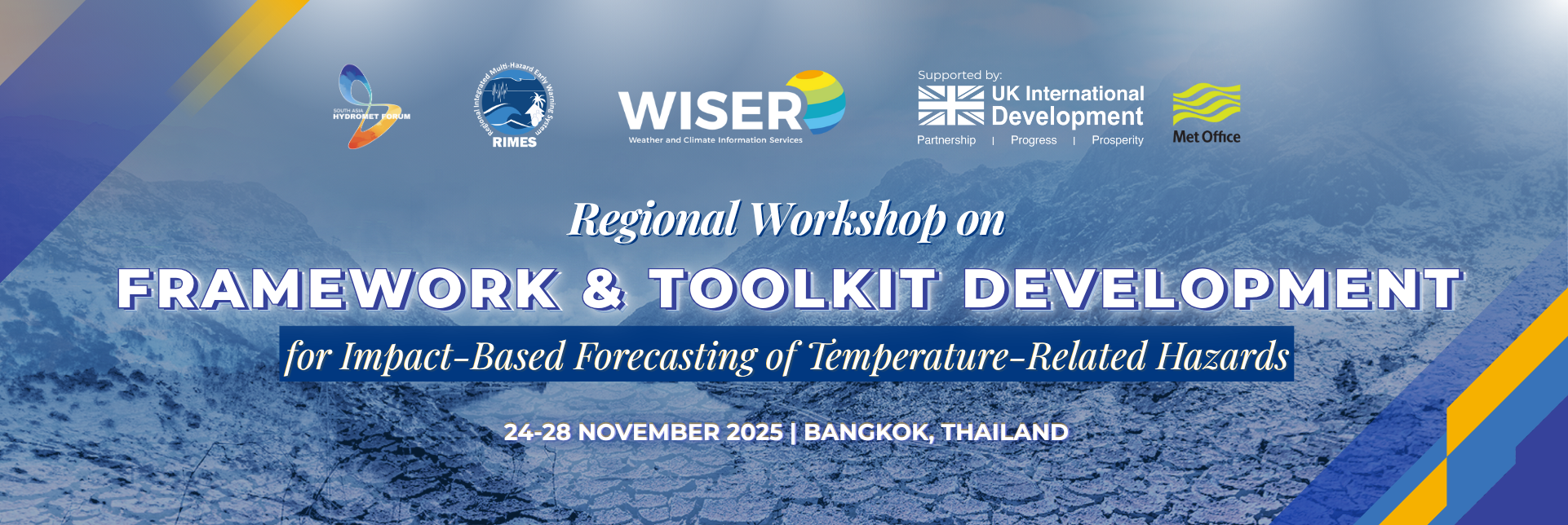
Regional Workshop on Framework & Toolkit Development for Impact Based Forecasting (IBF)
- Nov 24-28, 2025
- Bangkok, Thailand
One of the most pressing and rapidly worsening climate-related threats in South Asia is temperature extremes. Climate change is amplifying the frequency, intensity, and duration of temperature-related hazards, which include not only heatwaves but also cold spells and unseasonal low-temperature events. These extremes pose serious threats to public health, livelihoods, and infrastructure across the region. Rapid urbanization, widespread poverty, and a high dependency on climate-sensitive sectors – such as agriculture, water, health, and infrastructure – make the region exceptionally more sensitive to the growing impacts of climate change, particularly temperature extremes. These challenges highlight the urgent need to transition from conventional weather warnings to impact-based forecasting (IBF) that integrates hazard, exposure, and vulnerability information to provide actionable insights for decision-makers.
In response, the Regional Integrated Multi-Hazard Early Warning System for Africa and Asia (RIMES), in partnership with the UK Met Office through the Weather and Climate Information Services for Asia and the Pacific (WISER-AP) Programme, is implementing the South Asia Hydromet Forum (SAHF) IBF Working Group (WG) Project. This initiative aims to support South Asian countries in developing the scientific, institutional, and operational frameworks required to deliver IBF services, with initial focus on temperature-related hazards such as heatwaves and cold waves.
This regional workshop contributes to the project by facilitating the co-development of a regional Framework and Toolkit for IBF of Temperature-Related Hazards – a crucial output that will form the foundation for national demonstration activities and regional harmonization in 2026.
- Overview
- Agenda
This regional workshop contributes to the project by facilitating the co-development of a regional Framework and Toolkit for IBF of Temperature-Related Hazards – a crucial output that will form the foundation for national demonstration activities and regional harmonization in 2026.
The Workshop aims to:
- Co-develop a regional framework and toolkit for IBF of temperature-related hazards, aligned with WMO service delivery principles.
- Establish regional guidelines and selection criteria for national demonstration projects under the SAHF IBF initiative.
- Support participating countries in designing draft national demonstration workplans, integrating MEL, GESI, and risk management components.
- Consolidate outputs into a preliminary regional package (Framework v1, Toolkit v1, demo guidelines, and draft country workplans) to guide 2026 implementation.
By the end of the workshop, participants will have jointly produced:
- Draft Regional IBF Framework v1 outlining governance, data, thresholds, triggers, and communication pathways;
- Draft Toolkit v1, including methodological templates, data workflow models, and user communication materials;
- Agreed guidelines and selection criteria for country-level demonstration projects; and
- Draft national demonstration workplans integrating MEL, GESI, and risk components.
The workshop will bring together representatives from:
- National Meteorological and Hydrological Services (NMHSs)
- Relevant user agencies (e.g., health, agriculture, disaster management, etc.)
- Development partners engaged in the SAHF IBF Working Group
DAY 1: 24th November 2025 Baseline, National Priorities, and IBF Best Practices | 09:00 AM – 17:00 PM (Bangkok Time, UTC+7) |
|||
|---|---|---|---|
| Session | Time | Details | Lead/Speaker(s) |
| Welcome and Opening Remarks and Introductions | 09:00 AM – 09:30 AM | Launching of the workshop, presentation of objectives, expected outputs, and agenda for the week; Participant introductions | RIMES, UKMO, WMO |
| Session 1: Baseline Assessment: Findings and Country Validations | 09:30 AM – 09:50 AM | Presentation of baseline assessment results and country-validated findings Output: Validated baseline and mapped national contexts | RIMES |
| Session 2: Draft Regional Framework Outline and Initial Inputs | 09:50 AM - 10:20 AM | Introduction of the draft structure of the regional IBF framework, including its core components Output: Shared understanding of the draft framework components | RIMES |
| Coffee/Tea Break | 10:20 AM – 10:35 AM | ||
| Session 3: Training-of-Trainors (ToT) Requirements, Cascading Model, and Technical Assistance | 10:35 AM – 11:05 AM | Presentation of the ToT approach, requirements for national representatives, and expectations for cascading knowledge in-country. Discuss the roles, selection considerations, and support mechanisms from RIMES and UKMO Output: Agreed ToT nomination requirements and list of initial country support needs | RIMES, UKMO |
| Session 4: Regional/National Priorities and Gaps | 11:05 AM – 12:15 PM | Structured breakout discussions to identify national IBF gaps, priority needs, and opportunities to align solutions with the regional framework Output: Consolidated list of regional and national priorities | RIMES, UKMO Workshop Participants |
| Lunch Break | 12:15 PM – 13:15 PM | ||
| Session 5: (Temperature-Related) IBF Best Practices and Case Examples | 13:15 PM – 14:00 PM | Presentations of regional best practices for heat- and cold-related IBF, including lessons from existing guidelines and action plans: - Brief Intro to IBF - Temperature Related Hazard in Bangladesh - IMD Heat Cold Wave | UKMO, RIMES, IMD, PMD (TBC) |
| Session 6: Partner Presentations | 14:00 PM – 14:55 PM | Presentations from development and knowledge partners on ongoing and relevant initiatives for linkages and synergies with SAHF IBF priorities: - Impact-Based Forecasting to inform WFP’s Preparedness and Anticipatory Action Program - Global Heat Health Information Network | Partners: - GHHIN - WMO - ESCAP - WFP |
| Coffee Break | 14:55 PM – 15:10 PM | ||
| Session 7: GEDSI Integration | 15:10 PM – 15:40 PM | Presentation of approaches for integrating GEDSI in temperature-related IBF, including mapping of vulnerable groups and support systems for HW/CW mitigation/impact minimization actions, and inclusive communication and threshold considerations: - GEDSI Integration In Temperature-Related IBF Output: GEDSI checklist for Framework and Toolkit | RIMES - GEDSI Specialist |
| Session 8: MEL, Learning Loops, and Demonstrating Transformational Change | 15:40 PM – 17:00 PM | Introduction of MEL requirements, proposed templates, and reporting expectations. Explanation of WISER’s transformational change focus and how it will be reflected in the framework and demonstrations: - MEL, Learning Loops, and Demonstrating Transformational Change - Demonstrating Transformational Changes Output: MEL skeleton for integration into Framework and Toolkit | RIMES, UKMO MEL Specialist |
DAY 2: 25th November 2025 Framework and Toolkit Development | 09:00 AM – 17:00 PM (Bangkok Time, UTC+7) |
|||
|---|---|---|---|
| Session | Time | Details | Lead/Speaker(s) |
| Recap of Day 1 | 09:00 AM – 09:10 AM | Summary of Day 1 sessions, key points, and outputs | Workshop Participant (to be nominated the day before) |
| Session 9: SAHF Knowledge Hub (SKHub) Community of Practice (CoP) Demonstration | 09:10 AM – 09:40 AM | Demonstration of the CoP feature in SKHub, including how members can join communities, post questions, exchange technical insights, and support continuous collaboration Output: Participants‘ understanding of how the CoP facilitates knowledge sharing and peer learning across the region | RIMES IT Expert |
| Session 10: Governance, Roles, and Coordination Mechanisms | 09:40 AM - 10:35 AM | Co-defining institutional roles, governance structures, and coordination between regional, national, and sub-national actors: - RIMES-Serving as Regional Mechanism under SAHF Umbrella Output: Draft governance map and role/responsibility matrix | RIMES/ UKMO + Workshop Participants |
| Coffee/Tea Break | 10:35 AM – 10:50 AM | ||
| Session 11: Terminologies and core concepts of IBF/IF, understanding the implications for temperature-related hazards | 10:50 AM – 12:00 PM | Introduction of fundamental terminologies and core concepts of temperature-related hazards and IBF/IF Co-development of region-wide hazard (heatwave, cold wave), exposure (who/what is at risk), vulnerability (who is most susceptible), and impact (health, economic, social outcomes) components/indicators Output: Regionally harmonized glossary of core components of temperature-related hazards and IBF/IF | RIMES/ UKMO + Workshop Participants |
| Lunch Break | 12:00 PM – 13:00 PM | ||
| Session 12: Hands-on exercise for co-developing the region-wide components of IBF/IF (Continuation of Session 10) | 13:00 PM – 16:45 PM | Continuation of the previous session with more orientation and hands-on exercise on the components/indicators of temperature related hazards IBF/IF - Hazard, vulnerability, exposure and impact Output: Key indicators for the temperature-related hazard, vulnerability and exposure | RIMES/ UKMO + Workshop Participants |
| Preparatory Brief for Day 3 | 16:45 PM – 17:00 PM | Reminders and logistical briefing for the UNESCAP side events under the 5th ESCAP Disaster Resilience Week | RIMES |
DAY 3: 26th November 2025 Visit to UN Headquarters (Bangkok) and Participation in SAHF-related Side Events at the 5th ESCAP Disaster Resilience Week |
||
|---|---|---|
| Session | Time | Details |
| Participants are highly encouraged and expected to attend the following side events, which are closely aligned with the SAHF IBF Project’s objectives and activities: | ||
| Building Heat Resilience through Subregional and Regional Cooperation: Learning and Perspectives from South Asia | 13:00 PM – 14:00 PM | Meeting Room A |
| Understanding Multi-Hazard Risk in Coastal Areas toward Enhancing Adaptation | 16:00 PM – 17:00 PM | Meeting Room A |
DAY 4: 27th November 2025 Framework and National Demonstration Introduction | 09:00 AM – 17:00 PM (Bangkok Time, UTC+7) |
|||
|---|---|---|---|
| Session | Time | Details | Lead/Speaker(s) |
| Recap of Day 2 | 09:00 AM – 09:30 AM | Summary of Day 2 sessions, key points, and outputs. Reflections from Day 3 ESCAP Side Events | Workshop Participant (to be nominated the day before) RIMES / UKMO |
| Session 13: From IBF/IF to operational scenario-based impact forecasting: Case studies and way forward | 09:30 AM – 12:30 PM (with break) | Presentation of IBF/IF case studies and regional best practices on communication approaches for IBF/EWS: - Piloting Anticipatory Action for Floods in Cambodia - RIMES : Experience in COMET - Incorporation of Advice into NSWWS Warnings Group Exercise: Draft plain-language warnings for different vulnerability groups (elderly, outdoor workers, urban poor) Output: Draft communication templates/messages for the Toolkit; Understanding of IBF process – from operations to action | RIMES, UKMO, National Center for Disease Control (NCDC) India |
| Lunch | 12:30 PM – 13:30 PM | ||
| Session 14: Data, Modelling and Forecast data workflow | 13:30 PM - 14:30 PM | Identification of data flows (observation, forecast data), APIs, and integration with DSS/portals (SKHub, RDAS): - Data, Modelling and Forecast Data Workflow Output: Draft data workflow notes for Toolkit | RIMES |
| Session 15: Guidelines for National Demonstrations | 14:30 PM – 15:15 PM | Presentation of the EOI template, selection criteria, and co-development of national demo guidelines Output: Validated guidelines and criteria for national demonstrations | RIMES |
| Coffee/Tea Break | 15:15 PM – 15:30 PM | ||
| Session 16: Stakeholder and Mechanism Mapping at Country Level | 15:30 PM – 17:00 PM | Identification of relevant national stakeholders, vulnerable groups, institutional mechanisms, data systems; align with framework/toolkit modules Output: Stakeholder and mechanism maps per country | Country Groups with Facilitators |
DAY 5: 28th November 2025 National Demonstrations and Workplan Development | 09:00 AM – 16:15 PM (Bangkok Time, UTC+7) |
|||
|---|---|---|---|
| Session | Time | Details | Lead/Speaker(s) |
| Recap of Day 4 | 09:00 AM – 09:15 AM | Summary of Day 4 sessions, key points, and outputs | Workshop Participant (to be nominated the day before) |
| Session 17: Country Draft Workplans | 09:15 AM – 10:15 AM | Countries begin drafting full national demonstration workplans (objectives, outputs, roles, timelines) using the Framework and Toolkit | Country Groups with Facilitators |
| Coffee/Tea Break | 10:15 AM – 10:30 AM | ||
| Session 18: People in Need (PIN) – Experience in Nepal | 10:30 AM - 10:45 AM | Presentation on PIN’s work in establishing and implementing Heat Action Plans in Nepal | People in Need (PIN) |
| Session 19: MEL, GEDSI, Risk in Demonstrations | 10:45 AM – 11:00 AM | Guidance on integrating monitoring, evaluation, risk management, and GEDSI considerations into draft workplans Output: Workplans incorporating MEL, GEDSI, and risk components. | RIMES / UKMO / Technical Experts |
| Continuation of Session 17: Country Draft Workplans | 11:00 AM – 12:30 PM | Continued drafting and refinement of workplans | Country Groups with Facilitators |
| Lunch Break | 12:30 PM – 13:30 PM | ||
| Session 20: Presentations of Country Workplans | 13:30 PM – 15:00 PM | Presentation of draft national demonstration plan per country; peer and partner feedback Output: Refined workplans | Country Groups |
| Session 21: Roadmap to Implementation | 15:00 PM – 15:30 PM | Agreement on timeline for EOI submission, technical review process, final selection of demo sites, and upcoming meeting schedule Output: Implementation roadmap and key milestones | RIMES/UKMO + All Participants |
| Coffee/Tea Break | 15:30 PM – 15:45 PM | ||
| Workshop Closing and Reflections | 15:45 PM – 16:15 PM | Closing reflections, commitments, and next steps; formal closing remarks | RIMES/UKMO + All Participants |