


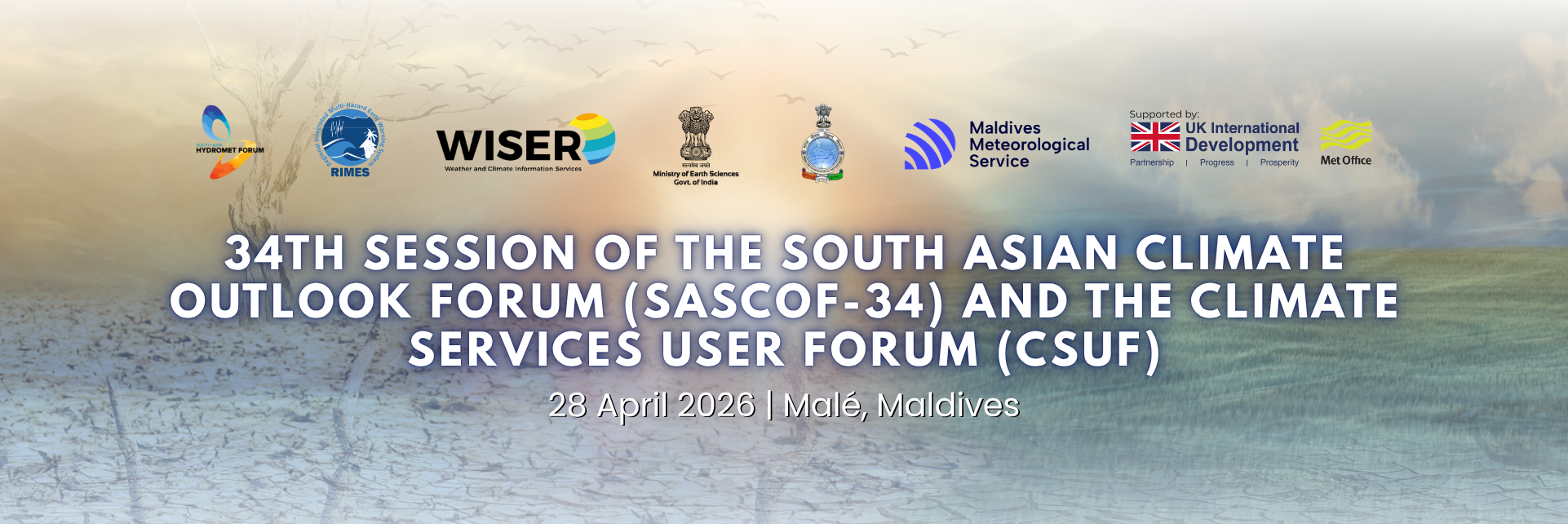
34th Session of the South Asian Climate Outlook Forum (SASCOF-34) for the Summer Season and Climate Services User Forum (CSUF)
- Apr 25-30, 2026
- Male, Maldives
South Asia continues to experience accelerating climate variability and extreme events, with the summer monsoon season (June–September) increasingly characterized by erratic onset, prolonged dry spells, short-duration extreme rainfall, heatwaves preceding monsoon onset, and compound flood–landslide events. In recent years, the region has witnessed record-breaking temperatures exceeding 50°C in parts of South Asia, deadly pre-monsoon heatwaves affecting millions, catastrophic flooding in Nepal and Pakistan triggered by intense rainfall episodes, and severe cyclonic activity in the Bay of Bengal impacting Bangladesh, India, and Sri Lanka. These events have underscored the growing volatility of monsoon behavior and its cascading impacts on agriculture, water security, food systems, public health, infrastructure, and national economies.
With nearly 70–80% of annual rainfall occurring during the summer monsoon in many South Asian countries, even modest deviations in timing, spatial distribution, or intensity can translate into significant socioeconomic consequences. With high population density, climate-sensitive livelihoods, and persistent vulnerability in several countries, there is a critical need for credible, consensus-based, regionally coordinated seasonal outlooks that can inform national planning, anticipatory action, and sector-specific preparedness measures. The South Asian Climate Outlook Forum (SASCOF) serves as a cornerstone regional mechanism to generate these consensus outlooks, ensuring scientific coherence across National Meteorological and Hydrological Services (NMHSs) and facilitating structured dialogue with user sectors through the Climate Services User Forum (CSUF).
Support to SASCOF and CSUF is central to achieving these objectives. SASCOF provides the technical platform for generating consensus seasonal outlooks, while CSUF ensures that these outlooks are interpreted, translated, and applied in sectoral decision-making contexts. However, recent assessments and the Training Needs Assessment (TNA) conducted under the SAHF CS WG project have identified critical gaps: varying levels of technical capacity in seasonal forecasting and probabilistic interpretation among NMHSs; limited integration of sub-seasonal and longer-term climate information; uneven understanding among user sectors of forecast uncertainty and application; and insufficient institutional feedback mechanisms between producers and users.
By embedding targeted pre-COF training for forecasters, structured CS WG deliberations, and sector-specific training for users alongside SASCOF and CSUF, the WISER AP-supported initiative ensures that seasonal outlook generation is technically robust, regionally harmonized, and practically usable. This integrated approach strengthens both sides of the climate services value chain—enhancing the scientific quality of outlooks and increasing their uptake in agriculture, water management, disaster risk reduction, health, and other climate-sensitive sectors.
- Overview
- Agenda
The week-long Climate Services activities is scheduled to be held on 25-30 April 2026 in Male, Maldives. Co-organized by the Maldives Meteorological Service (MMS), Regional Climate Center (RCC), Pune of India Meteorological Department (IMD), UK Met Office (UKMO), and the Regional Integrated Multi-Hazard Early Warning System for Asia and Africa (RIMES), it aims to strengthen regional coherence, technical capacity, and user engagement across South Asia by integrating targeted pre-COF Training, SAHF CS WG meeting, SASCOF, and CSUF.
It specifically targets to:
- Enhance technical capacity of seasonal forecasters through targeted pre-COF training informed by the TNA.
- Review progress and strategic direction of the SAHF CS WG, including assessment findings and training plan implementation.
- Develop a consensus seasonal outlook through SASCOF, supporting national climate outlook preparation.
- Strengthen interpretation and application of seasonal outlooks among user sectors through tailored training and CSUF dialogue.
- Promote inclusive, GEDSI-response climate services and strengthen feedback loops between producers and users.
SASCOF-34 – TUE 28 April 2026 34th SOUTH ASIAN CLIMATE OUTLOOK FORUM (SASCOF-34) 10:00 – 17:00 (UTC+5) | Malé, Maldives |
|||
|---|---|---|---|
| Session | Time | Details | Lead/Speaker(s) |
| Registration | 09:30 AM – 10:00 AM | ||
| Opening Session | 10:00 AM – 10:30 AM | - Recitation of Holy Quran - Remarks/Messages | - Dr. O.P. Sreejith, RCC-Pune, IMD - Director General Abdulla Wahid, MMS - Dr. Anshul Agarwal, RIMES-SAHF |
| Participants' Introduction | 10:30 AM - 10:50 AM | ||
| Group Photo Opportunity | 10:50 AM - 11:00 AM | ||
| Tea Break | 11:00 AM – 11:30 AM | ||
| Session I: Seasonal Prediction of South Asia for JJAS Season 2026 – Country Perspectives (Part 1) | |||
| Afghanistan | 11:30 AM - 11:40 PM | ||
| Bangladesh | 11:40 AM – 11:50 PM | ||
| Bhutan | 11:50 AM – 12:00 PM | ||
| Lunch Break | 12:00 PM – 13:00 PM | ||
| Session I: Seasonal Prediction of South Asia for JJAS Season 2026 – Country Perspectives (Part 2) | |||
| India | 13:00 AM – 13:10 PM | ||
| Maldives | 13:10 AM – 13:20 PM | ||
| Myanmar | 13:20 PM – 13:30 PM | ||
| Nepal | 13:30 PM – 13:40 PM | ||
| Pakistan | 13:40 PM – 13:50 PM | ||
| Sri Lanka | 13:50 PM – 14:00 PM | ||
| Open Discussion | 14:00 PM – 14:10 PM | ||
| Session II: Seasonal Prediction of South Asia for JJAS Season 2026 – Global and Regional Perspectives | |||
| Introduction of Emerging ENSO indices and its application | 14:10 PM – 14:30 PM | - Presentation | - Dr. Sabeerali, C.T., RCC-Pune |
| Health / Tea Break | 14:30 PM – 14:50 PM | ||
| JMA's Seasonal Prediction of South Asian Climate for JJA 2026 | 14:50 PM – 15:10 PM | - Presentation | - Ken Yamada, Tokyo Climate Center-Japan Meteorological Agency (TCC-JMA) |
| Global and Regional Perspectives: WMO Lead Center for Long-Range Forecast | 15:10 PM – 15:25 PM | - Dr. Jeongmin Han, APEC Climate Center (APCC) | |
| Global and Regional Perspectives: UK Met Office | 15:25 PM – 15:40 PM | - Andrew Colman, UKMO | |
| Global and Regional Perspectives: IRI | 15:40 PM – 15:55 PM | - IRI | |
| Pre-Consensus Presentation and Discussion on Outlook: RCC, IMD, Pune | 15:55 PM – 16:10 PM | - Dr. Sreejith O.P., RCC/IMD | |
| Agreement / Final Remarks on the Draft Text of the Consensus Forecast for JJAS 2026 | 16:10 PM – 16:30 PM | ||
| End of SASCOF-34 Program | |||
DAY 1 – 29 April 2026 (Wednesday) Climate Services User Forum (CSUF) 9:00 – 16:00 (UTC+5) | Malé, Maldives |
|||
|---|---|---|---|
| Session | Time | Details | Lead/Speaker(s) |
| Registration | 08:30 – 09:00 | ||
| Opening / Inaugural Session | 09:00 – 09:45 | - Recitation of Holy Quran - Remarks/Messages | - Dr. O.P. Sreejith, RCC-Pune, IMD - Maldives Honourable Minister for Tourism and Environment - Mr. David Corbelli, UKMO - Dr. Anshul Agarwal, RIMES-SAHF |
| Overview of the Forum, Participant Acknowledgment | 09:45 – 10:20 | ||
| Group Photo Opportunity | 10:20 – 10:30 | ||
| Health / Tea Break | 10:30 – 10:50 | ||
| Session I: SASCOF-34 Consensus Outlook for JJA 2026 Season (RCC-Pune) | |||
| Presentation of SASCOF-34 Consensus Outlook | 10:50 – 11:05 | - Dr. Sreejith, RCC/IMD | |
| Presentation on Impact Outlook Developed for the South Asian Region at SASCOF-34 and its implications for key sectors | 11:05 – 11:20 | - | - Leila/Rahul, ESCAP |
| Session II: Sub-Seasonal Products and their Utilisation (RCC-Pune) | |||
| Extended-Range Forecast Products | 11:20 – 11:35 | - Dr. Susmida, IITM | |
| S2S Forecast Products from NCMRWF | 11:35 – 11:50 | - Ankur Gupta | |
| Introduction of Recent Updates of Tokyo Climate Center (TCC)’s Services | 11:50 – 12:00 | - Mr. Ken Yamada, TCC-JMA | |
| Lunch Break | 12:00 – 13:00 | ||
| Session III: Status of Climate Services and Impact-Based Forecasting (RIMES Team) | |||
| Presentation of the Regional Assessment on the Status of Climate Services and TNA Report | 13:00 – 13:20 | - Dr. Anshul Agarwal, RIMES | |
| Session IV: Interpretation of Climate Information and Products | |||
| Forecasting Impact of Climate Drivers on Agricultural Sector: An ongoing research at RIMES | 13:20 - 13:40 | - Raihanul Haque Khan, RIMES | |
| Interpretation of Seasonal Outlooks, Probabilistic Forecasts, and Climate Advisories | 13:40 – 14:10 | - Dr. Jane Strachan, UK Met Office | |
| User Sector Presentation | 14:10 – 14:25 | - Dr Jothiganesh Shanmugasundaram, WFP | |
| Health / Tea Break | 14:25 – 14:40 | ||
| Session V: Case-based Discussions: Application of Climate Services in Decision-Making | |||
| Climate Services for Disaster Management | 14:40 – 14:50 | - Ms. Faroosha Ali Naseer, NDMA Maldives | |
| Climate Services for Agriculture: SESAME DSS (Bhutan) | 14:50 – 15:00 | - Ms. Tshering Pema, Department of Agriculture Bhutan | |
| Experience-sharing from the User Sectors | 15:00 – 15:10 | - Nirmala Regmi, NDRRMA & Puja Shakya, RIMES | |
| Panel Discussion: Experience-sharing from the User Sectors | 15:10 – 15:40 | - Moderator: Raihanul Haque Khan | |
| Open Discussion | 15:40 – 16:00 | ||
DAY 2 – 30 April 2026 (Thursday) Climate Services User Forum (CSUF) 9:00 – 16:00 (UTC+5) | Malé, Maldives |
|||
|---|---|---|---|
| Session | Time | Details | Lead/Speaker(s) |
| Registration, Recap of Day 1 | 09:00 – 09:20 | ||
| Framing and Objectives | 09:20 – 09:25 | - Dr. Roxy Mathew Koll, IITM | |
| Seasonal Heat Outlook for Indian Region and South Asia | 09:25 – 09:40 | - Dr. Rohini P., IMD / WMO RCC | |
| Sub-seasonal Heat Outlook and Forecast Use for Early Action | 09:40 – 09:55 | - MD / NCMRW | |
| Heat-Health Advisory and Public Health Preparedness | 09:55 – 10:10 | - Dr. Aakash Shrivastava, NCDC/MOHFW | |
| Heat Risk Preparedness in Maldives | 10:10 – 10:25 | - Shri Hisan Hassan, NDMA, Maldives | |
| Health / Tea Break | 10:25 – 10:45 | ||
| From Forecasts to Action: Synergizing Heat Health Resilience across Meteorology, Health Sectors, and Communities in South Asia | 10:45 – 11:00 | - Dr. Novil Wijesekaram, Sri Lanka | |
| Heat Risk Preparedness in India | 11:00 – 11:15 | - Shri Krishna Vatsa, NDMA India | |
| Roundtable Discussion with Experts | 11:15 – 11:30 | ||
| Key Takeaways and Next Steps | 11:50 – 12:00 | ||
| Lunch Break | 12:00 – 13:00 | ||
| Climate Services in the Health Sector: WMO-WHO Initiatives for South Asia (continuation) | 13:00 – 13:15 | - Dr. Vishwas Chitale, GHHIN South Asia | |
| Session VII: Analyzing Communicating Sector Specific Climate Risks | |||
| Demonstration of the INSTANT South Asia Portal | 13:15 - 13:30 | - RIMES | |
| Interactive Session: Co-Production of Climate Outlook and Advisories Improving awareness and dissemination of climate information within sector institutions and communities | 13:30 – 14:40 | - Raihanul Haque Khan & Asif Uddin Bin Noor, RIMES | |
| Tea Break | 14:40 – 15:00 | ||
| Session VIII: Using Long-Term Climate Information | |||
| Use of Climate Projections to Support Infrastructure Planning and Climate Adaptation Strategies | 15:00 – 15:30 | - IITM (online) & ESCAP | |
| Open Discussions | 15:30 – 15:50 | ||
| Way Forward and Closing Remarks | 15:50 – 16:00 | ||