
SLMC Regional Review and Planning Workshop and Flood Forecasting on a Shoestring Budget (FFSB) Technical Workshop
- Jun 08-11, 2026
- Novotel Bangkok Future Park Rangsit, Pathum Thani, Thailand
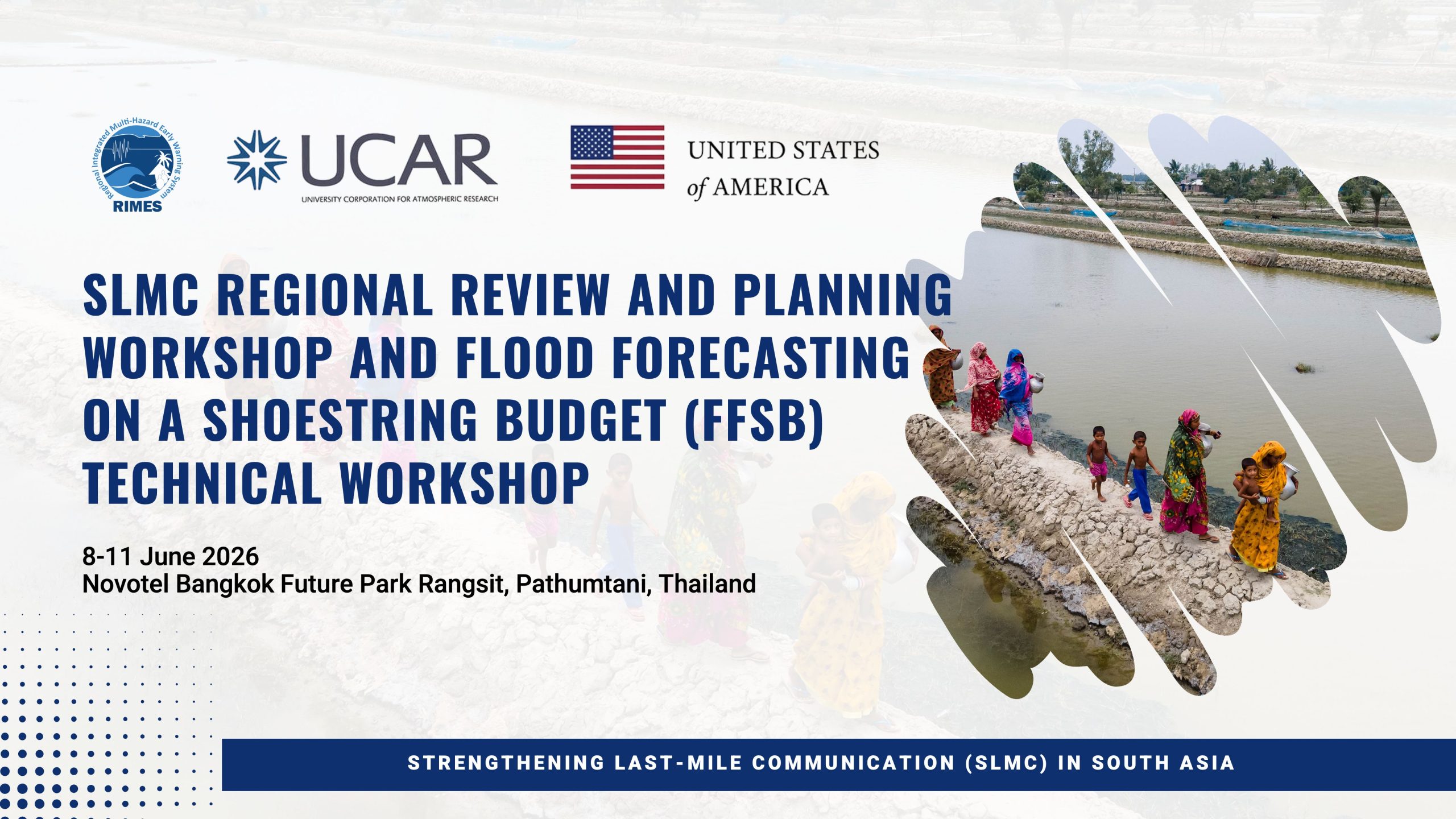
The “Strengthening Last Mile Communication (SLMC) in South Asia Project” is being implemented by RIMES in pilot locations in Bangladesh, Nepal, Pakistan, and Sri Lanka to build climate resilience through improved access and use of early warning information among last-mile users in the region. More than two years since the project started in October 2021, it has accomplished various activities anchored towards this objective, including the implementation of forecast interpretation trainings, community-based DRM activities (e.g., hazard, exposure, vulnerability and capacity assessment, search and rescue [SAR], and first aid trainings, DRM simulations, etc.), customization of the Integrated Forecast Dissemination Portal (INSTANT), installation and distribution of low- cost early warning system (EWS) and communication equipment, and support to local level DRM planning. The implementation of the SLMC project has been made possible through the valued support of the University Corporation for Atmospheric Research (UCAR), initially with generous funding from the United States Agency for International Development (USAID), and is presently sustained by the Bureau of Population, Refugees, and Migration (PRM) / Office of International Disaster Response (IDR) of the U.S. Department of State.
Mid-term during the course of project implementation, intervening similar initiatives and developments from other humanitarian agencies, focusing in the same pilot countries/ areas, opened opportunities for project complementation and synergies to maximize available resources and prevent duplication of efforts. Some of these similar undertakings include the Scaling-up Forecast-based Action and Learning (SUFAL) Project, Climate Adaptation and Resilience (CARE) Programme, South Asia Hydro-met Forum (SAHF), and the Asia Regional Resilience to a Changing Climate (ARRCC) Programme, among others.
In view of this opportunity for complementation, the request has been received to modify and/or expand some of the project activities based on emerging demands from the stakeholder partner agencies in the beneficiary countries. The supplemental project activities to be implemented include the provision of support for the conduct of local-level seasonal/ monsoon forums to help local authorities formulate seasonal preparedness strategies and plans, and the inclusion of disaster risk management (DRM) field schools in community-based DRM programs to strengthen local disaster risk knowledge and management capacity. This will ensure that by the end of the project, specific indicators defined in a to-be-developed community hazard-ready qualification guidelines, tailored for priority hazards identified in the target locations, will be met and accomplished in the pilot communities.
As the SLMC project enters its final implementation phase, there is a need to systematically review progress achieved across the pilot countries, document lessons learned, identify remaining operational and institutional gaps, and strengthen sustainability arrangements with government partners. The project has generated valuable experiences in strengthening last-mile communication, impact-based forecasting, community preparedness, and disaster risk management planning, which provide important lessons for future investments in people-centered early warning systems. The regional workshop will provide a platform for participating countries to exchange experiences, assess implementation progress, identify successful practices for replication and scaling, and develop recommendations for sustaining and expanding project outcomes beyond the current implementation period.
- Overview
To support an end-of-program stocktake of SLMC implementation and strengthen handover readiness with government partners, a four-day regional event will be held at the Novotel Bangkok Future Park Rangsit, Pathum Thani, Thailand, combining: (i) a one and half day SLMC regional review and forward
planning workshop and (ii) a two-and-a-half-day Flood Forecasting on a Shoestring Budget (FFSB) technical workshop. The SLMC segment will align partners on remaining deliverables, identify integration opportunities with complementary initiatives, and agree on practical priorities to sustain last-mile early warning services. The FFSB segment will convene selected experts and country representatives to share low-cost, scalable flood forecasting approaches and technical lessons applicable across the region.
The workshop hopes to achieve the following objectives:
- Regional SLMC review and knowledge sharing across pilot countries
- Planning and prioritization for remaining SLMC activities and strengthened handover readiness
- INSTANT platform and associated tools: technical progress review and country requirements alignment
- Identify priorities and opportunities for a future phase of SLMC and scaling of successful approaches
- FFSB technical workshop: shared understanding of the approach and practical steps for application
- Consolidate operational readiness and agree practical country-level pathways to apply FFSB within existing early warning systems.
Participants
The workshop will bring together approximately 20–25 participants from Bangladesh, Nepal, Pakistan, Sri Lanka, Bhutan, Thailand, Philippines, Vietnam, Indonesia, Maldives, Laos and India including representatives from National Meteorological and Hydrological Services (NMHSs), disaster management authorities, local government institutions, and SLMC project focal points. The workshop will also include technical experts from UCAR and partner institutions, as well as RIMES technical and program staff.
The FFSB component will additionally engage forecasting specialists and practitioners interested in exploring low-cost, scalable flood forecasting approaches suitable for operational implementation in resource-constrained environments.